The Eternal Machine launched last week 14th January, and at last I feel as if I’ve reached the first milestone of a very long fourteen-year journey. It was my first novel, one I didn’t think I would ever publish, and almost ended up in the trash basket forever. Instead, I decided to use it to work my way through the entire learning process of writing longer fiction. I used it to learn how to write character, then plot, dialogue, world building, emotion, description. At times it felt as if I were painting a picture, adding each layer at a time, making sure they not only complemented each other but also interacted. Now that it’s done, I’m glad I stuck with it. Using input I received from critters, editors, beta readers and now reviewers, the ongoing process feels like a masterclass with my own work as a focus.
I was therefore delighted to receive a review from spec fiction writer and book blogger Leanbh Pearson, who summed up her commentary with:
A new steampunk read from a debut author in the genre. Highly sophisticated world-building with combination of alternate history, steampunk and gaslamp fantasy makes this suitable for audiences of all three genres. A well-recommended read!
At last, The Eternal Machine will be released tomorrow, Friday 14th January! I’m excited, a little bit scared and happy to have nearly met the goal I made 14 years ago. If you like weird steampunk, gothic urban fantasy with lots of strong female characters, and a little bit of Leibniz, then this may be for you.
I must admit the scariest part was putting it up on NetGalley via BooksGoSocial a couple of months ago. But I bit the bullet and jumped in, and received an interesting mix of reader reactions, which are now on Goodreads. I took a few risks with this book by including themes that I care about and are as much a reflection of the present world as the novel’s nineteenth century setting; but that’s what a lot of steampunk is about, isn’t it? Taking risks.
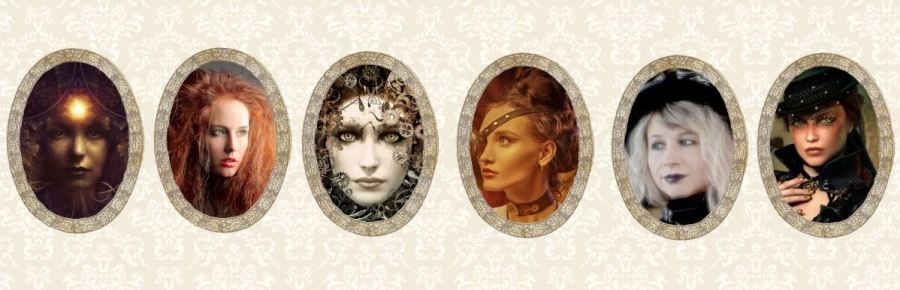
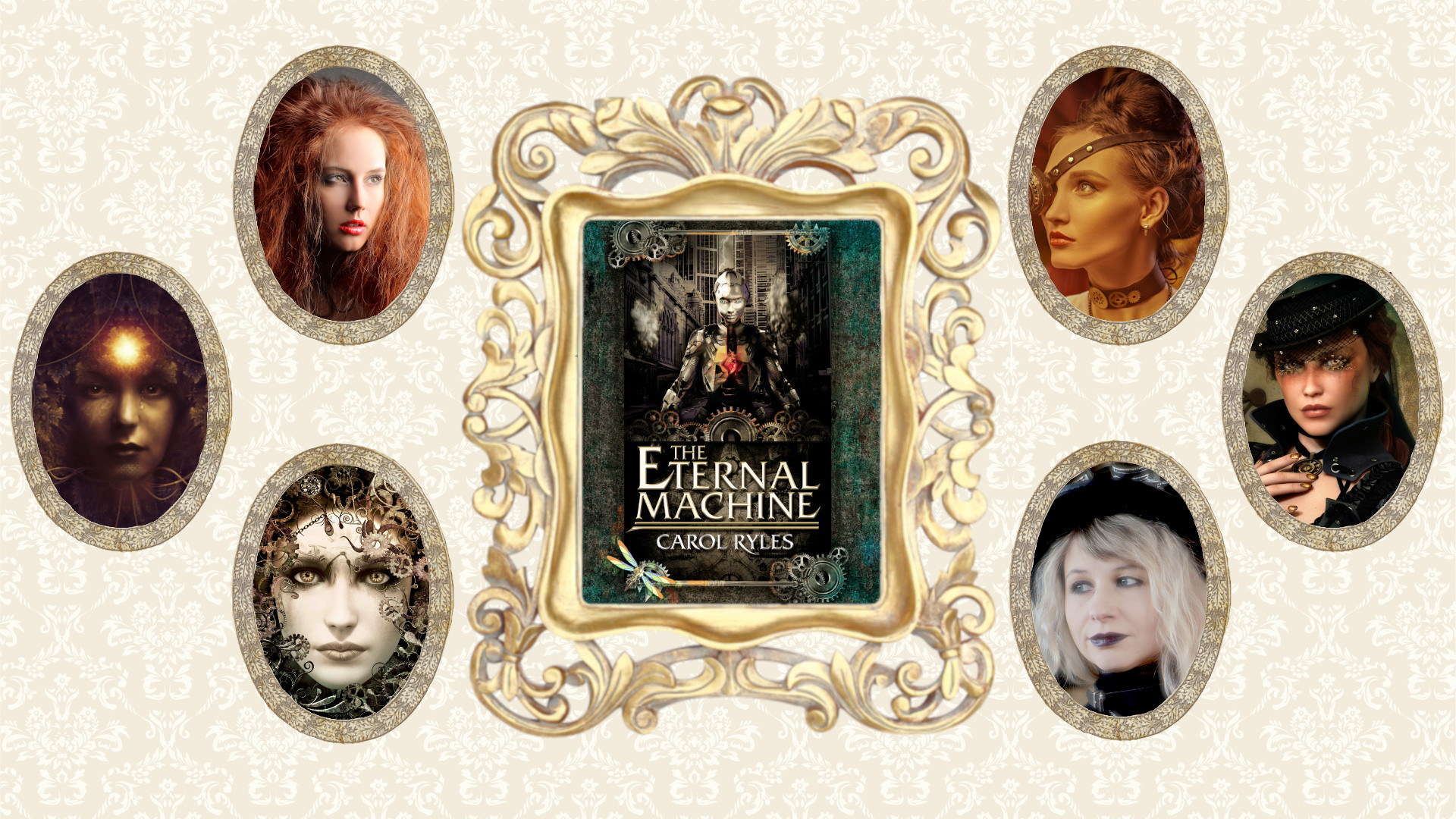
Anyhow, allow me to introduce you to some of my girls.
Starting from Top Right and moving Clockwise:
1. Em is an underpaid & underemployed mechanic who dreams of being a designer, but has little chance in a city owned by industrialists; so becomes a rebel instead.
2. Solly is a resistance fighter, Em’s friend and mentor; and is a wise and natural leader.
3. Lottie is a shapeshifter trapped in the body of a human. She is wise, irreverent, witty, flippant and loves smoking cigars.
4. Phidelia is on a mission, but her unconventional behaviour has many tongues wagging against her. She ignores this narrowmindedness with all the contempt it deserves.
5. Orla is spectacularly badass and somewhat corrupted. She wants to rid the city of industrialists, but cares little about who she hurts along the way.
6. Myrtle has worked as a horologist for 24 years. She is a rebel, Em’s mentor and is fiercely protective of her younger brother who is very very tall.
Furthermore, there are also some kick-ass male characters, some good, some bad, and some a bit of both.
In a recent post in Locus Online, Science Fiction is a Luddite Literature, Cory Doctorow writes about how science fiction and Luddism concern themselves with the same question: “not merely what technology does, but who it does it for and who it does it to.” In other words: “the social relations that governed its use.”
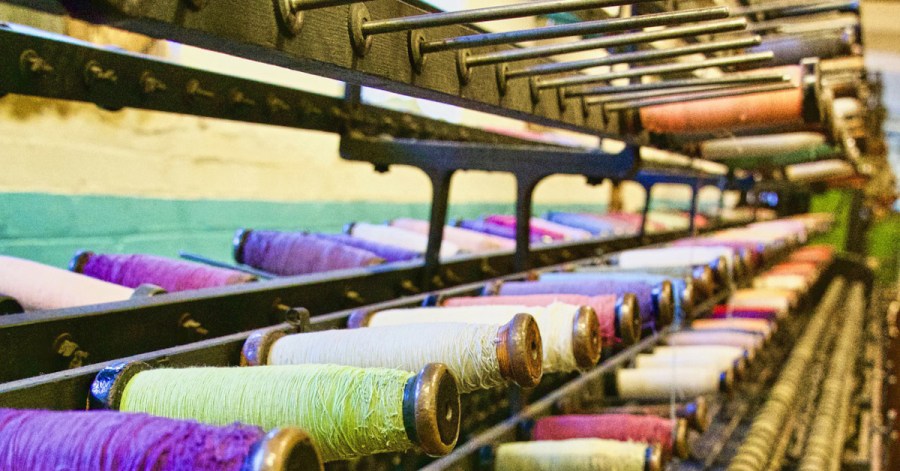
Doctorow dispels the myth that luddites fought against technology and argues that they instead opposed the exploitation of workers when automation made production of textiles faster and cheaper. It’s not hard to guess who reaped the benefits: Not the workers who manned the machines for longer and longer hours, but the wealthy industrialists who owned them.
Some would say those days are behind us. But are they? Most of our clothing comes from developing countries whose workers earn less than it costs to live. Similarly, the motor manufacturing industry in Australia has vastly shrunk for the same reasons. As a result, manufacturers and retailers enjoy higher profits and consumers buy products at a lower price.
But what about the workers? The ones whose rights have either been eroded or are nonexistent, whose efforts lead to longer hours and less pay?
Back in the 60’s my dad was a production supervisor in a big brand bread factory. He worked terrible hours starting at 2am and earned a miserly salary. Someone had told him he wasn’t allowed to join a union, but I suspect he probably could have.
We lived in a working class western Sydney suburb in a cheaply-built fibro house with a tiny mortgage, but my parents could barely make ends meet. At 40 years old, my dad was diagnosed with emphysema. Yes, he was a smoker, but he was also exposed to flour-laden air every working night, a common cause of bakers asthma. He also lost the tips of two fingers when they got caught up in the workings of one of the machines.
My grandfather fared even worse. A merchant seaman, he lost the use of his hands in a boiler accident in the 1930s. As a result, my mum grew up in poverty and was pulled out of school and sent to work as a machinist in a clothing factory at the age of fourteen. She told us some terrible stories about that!
These days, despite a few positive steps in the right direction, workers are still subjected to wage theft, unsafe conditions, wage freezes and regressive tax systems that keep many people on or below the poverty line. Meanwhile mega corporations strive for record-breaking profits.
Science fiction writers have not only been critiquing, but also predicting these kind of scenarios for decades. The movie, Metropolis (1927) is a very early example. And more recently Elysium (2013).
A notable example in books is: HG Wells’s prophetic The Sleeper Awakes (1910) where a 19th C activist is transported to the year 2100 to find the workforce is still facing oppression. Another is The Windup Girl by Paolo Bacigalupi (2009) where the world is controlled by big corporations.
Steampunk also contributes to the critique, but through a backward looking lens. One of my favourites is The Iron Dragon’s Daughter (1994) by Michael Swanwick, which begins in a factory where slaves manufacture flying dragon automatons. Another is Worldshaker (2009) by Richard Harland, where workers toil in the lower decks of a city-sized roving machine, the industrial equivalent of a Howl’s Moving Castle on wheels.
Texts such as these inspired my own novel, The Eternal Machine. As did Emile Zola’s Germinal (1885) and the many books of Charles Dickens.
The exploitation of factory workers may well have began with the Industrial Revolution, but its roots went back further than that in the medieval feudal system, and earlier still. Hundreds of years later, the injustices and inequalities continue unabated.

 CAROL RYLES